OpenTalk No.86 | The Academic Impact of Open Science
Abstract
Open Science seeks to make research processes and outputs more accessible, transparent and inclusive, ensuring that scientific findings can be freely shared, scrutinized and built upon by researchers and others. To date, there has been no systematic synthesis of the extent to which Open Science (OS) reaches these aims. In this talk I present results from conducting a PRISMA scoping review to map the evidence on the academic impacts of OS. We identified 485 studies related to all aspects of OS, including Open Access (OA), Open/FAIR Data (OFD), Open Code/Software, Open Evaluation and Citizen Science (CS). Analysing and synthesizing findings, we show that the majority of studies investigated effects of OA, CS and OFD. Key areas of impact studied are citations, quality, efficiency, equity, reuse, ethics and reproducibility, with most studies reporting positive or at least mixed impacts. However, we also identified significant unintended negative impacts, especially those regarding equity, diversity and inclusion. Overall, the main barrier to academic impact of OS is lack of skills, resources and infrastructure to effectively re-use and build on existing research. Building on this synthesis, I identify gaps within this literature and draw implications for future research and policy.
分享嘉宾:

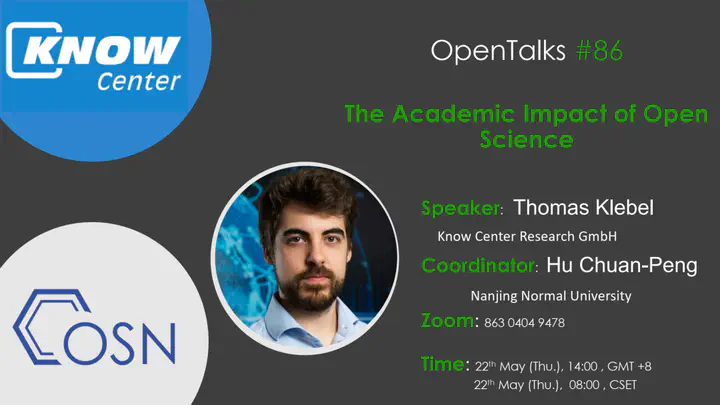
Thomas Klebel is a member of the Open and Reproducible Research Group and a Senior Researcher at Know Center. In his research, he investigates unintended consequences of current implementations of Open Research, ways of improving the reproducibility of research findings, and avenues for sustainable business models around open research infrastructure. With a focus on quantitative methods of inquiry, he is also keenly interested in causal modelling and ways of improving research practice. Thomas completed his doctoral studies in Sociology in 2024 and holds a degree in Music Performance from the University of Performing Arts Graz. You can find him on ORCID and LinkedIn.